
Transport of transformers, generators and wind turbine components
Power equipment is among the heaviest and most sensitive loads on the road. We organise its transport from the factory or the port to the substation, power plant or wind farm, with a checked route, a transport engineering study and permits from every road administrator.
At a glance
- Power transformer
- often over 100 t
- Wind turbine blades
- can exceed 50 m in length
- Key documents
- transport engineering study and AST permit
- Common entry point
- Port of Constanța
Transformers and generators
A power transformer can weigh more than 100 tonnes, concentrated on a small area. For such pieces, the axle load matters more than the gross weight: if it exceeds the values that can normally be authorised, the permit is issued only on the basis of a transport engineering study.
We use modular trailers with axle lines added according to weight and, where the height requires it, low-deck trailers. Transformer manufacturers usually set acceleration limits and require a shock recorder during transport; we include them in the transport plan and adapt the speed and the route.
Wind turbine components
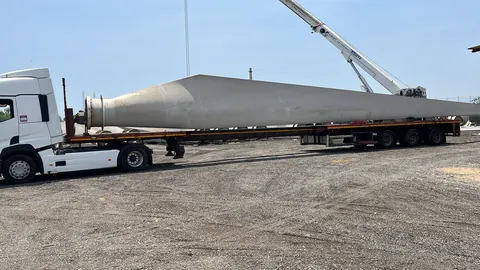
Blades over 50 metres long, heavy tower sections and nacelles that need modular trailers: a wind farm means dozens of oversize transports that must arrive in the order of installation. Many components arrive by sea, through the Port of Constanța, and continue by road to the site.
For blades we use extendable trailers, and for tower sections, adapters and dedicated trailers. Along the route we check tight bends, roundabouts and access on the wind farm's service roads.
Solar parks and transformer stations
Solar panels usually travel as standard freight. The oversize items are the transformer stations, the containerised inverters and the grid connection transformers. We schedule them together with the installation, so that the crane is on site when the truck arrives.
When the route has to be prepared
Sometimes the road is not ready for the transport: an overhead cable is too low, a road sign is in the way of the overhang or a bridge needs checking. Under OG no. 43/1997, the works required along the route (adjustments, reinforcements, alterations to overhead or underground utilities) are the responsibility of the permit holder.
We identify them during the route survey and include them in the plan and the budget, so that there are no surprises on the day of departure.
Power equipment to and from Europe
We bring transformers, generators and wind turbine components from manufacturers across Europe, by road or combined with sea freight.
- GermanyVEMAGS, BF3/BF4 escort, machinery from dealers and auctions
- Austriapermit from the state government, transit to the west
- Italytrasporto eccezionale, ANAS and the regions, production lines
- SpainDGT and regional authorities, route through France
- TurkeyKGM road document, A.TR certificate, customs
- Polandseven permit categories, pilot vehicle from 3.2 m width
From our transports
Questions about transporting power equipment
Why does a transformer need a transport engineering study?
Because the axle loads usually exceed the values that can be authorised directly. In that case, the rules require a transport engineering study drawn up by a licensed person, who checks the route and the structures along it.
Can you bring a transformer from the port to the substation?
Yes. We coordinate the collection from the port, the road transport, the escort and the unloading onto the foundation, together with the installation team.
Who deals with overhead cables or road signs along the route?
The permit holder is responsible for the works needed along the route. We identify them, obtain the consent of the utility owners and schedule the interventions before the transport.
Do you also transport components for solar parks?
Yes: the oversize equipment, such as transformer stations and technical containers, as well as the panels and mounting structures, as standard freight.
Read also
Do you have power equipment to transport?
Tell us what we are moving, from where and to where. We send you a tailored quote, for most requests in under 30 minutes during office hours.
- Phone+40 31 631 8931
- Emailcontact@transport-agabaritic.net
- Office hoursMonday–Friday, 09:00–17:30 (Romanian time)